d2jsp
Log InRegister
d2jsp Forums > Off-Topic > General Chat > Science, Technology & Nature > Close Encounter With Comet 67p > May Reveal Origins Of Life On Earth
Prev18910111251Next
Add Reply New Topic New Poll
Member
Posts: 28,331
Joined: Jun 9 2007
Gold: 11,700.00
Oct 14 2014 05:49am
Soon, hopefully:

http://www.youtube.com/watch?feature=player_detailpage&list=UU2iaRtEaE3Xbj3wPBot1-ZQ&v=-77-Z_DHTlY

This post was edited by brmv on Oct 14 2014 05:49am
Member
Posts: 28,331
Joined: Jun 9 2007
Gold: 11,700.00
Oct 15 2014 04:34am
Here another selfie:


Using the CIVA camera on Rosetta’s Philae lander, the spacecraft have snapped a ‘selfie’ at comet 67P/Churyumov–Gerasimenko from a distance of about 16 km from the surface of the comet. The image was taken on 7 October and captures the side of the Rosetta spacecraft and one of Rosetta’s 14 m-long solar wings, with the comet in the background.
Two images with different exposure times were combined to bring out the faint details in this very high contrast situation. The comet's active ‘neck’ region is clearly visible, with streams of dust and gas extending away from the surface.


plus

The primary landing site, currently known as Site J, can also be seen on the smaller lobe of the comet.

and

The 7 October selfie is the last image from Philae before the lander separates from Rosetta on 12 November. The next image will be taken by CIVA shortly after separation, when the lander will look back at the orbiter to bid it a final farewell. While the lander’s ROLIS instrument will take images during the descent phase, CIVA will be tasked with making a 360 degree panoramic image of the landing site, including a section in stereo, once safely on the surface of 67P/C-G. The images and other data collected by Philae will provide important in situ information about this particular region on the comet, providing ‘ground truth’ data that can be used to complement the data collected for the whole comet from the Rosetta orbiter now and into 2015, as the comet becomes more active.
Final confirmation of the landing site and its landing scenario is under discussion today at ESA’s Lander Operations Readiness Review, being held at ESOC in Darmstadt. A formal announcement of the outcome will be made tomorrow, 15 October.


Should come up every hour now :)
Member
Posts: 28,331
Joined: Jun 9 2007
Gold: 11,700.00
Oct 15 2014 05:20pm
15 October 2014
ESA has given the green light for its Rosetta mission to deliver its lander, Philae, to the primary site on 67P/Churyumov–Gerasimenko on 12 November, in the first-ever attempt at a soft touchdown on a comet.
Philae’s landing site, currently known as Site J and located on the smaller of the comet’s two ‘lobes’, was confirmed on 14 October following a comprehensive readiness review.


Philae's primary landing site from 30 km

Rosetta will release Philae at 08:35 GMT/09:35 CET on 12 November at a distance of approximately 22.5 km from the centre of the comet. Landing will be about seven hours later at around 15:30 GMT/16:30 CET.
With a one-way signal travel time between Rosetta and Earth on 12 November of 28 minutes 20 seconds, that means that confirmation of separation will arrive on Earth ground stations at 09:03 GMT/10:03 CET and of touchdown at around 16:00 GMT/17:00 CET.


What does Philae do during descent?

A detailed operations timeline, including key Go/No-Go decisions leading up to separation, will be available soon.
Member
Posts: 2,694
Joined: Aug 19 2013
Gold: 0.00
Oct 16 2014 05:24pm
Thanks for the share quite awesome to study.
Member
Posts: 28,331
Joined: Jun 9 2007
Gold: 11,700.00
Oct 17 2014 08:39pm
A short video which compares the size of the probe to that of the comet on this link:

http://www.esa.int/spaceinvideos/Videos/2014/10/How_big_is_Rosetta_compared_with_the_comet
Member
Posts: 28,331
Joined: Jun 9 2007
Gold: 11,700.00
Oct 19 2014 08:29am
Getting closer:


Four-image montage comprising images taken by Rosetta's navigation camera on 15 October from a distance of 9.9 km from the centre of Comet 67P/Churyumov-Gerasimenko. The image scale is about 0.63 metres/pixel, so each 1024 x 1024 pixel frame making up the montage is about 650 metres across.
Of course, at these close distances that’s only really valid for the nearside of the comet. With the furthest point being an additional ~1 km further from the centre, that reduces the image scale for the more distance frames to about 0.93m/pixel!
The orientation is such that we’re looking down onto the small lobe from above (bottom two frames), with the large lobe beyond (top two frames).
Member
Posts: 28,331
Joined: Jun 9 2007
Gold: 11,700.00
Oct 20 2014 05:50am
Today a little history lesson, it might be a long read but it might be interesting for those who don't know - starting with pictures:
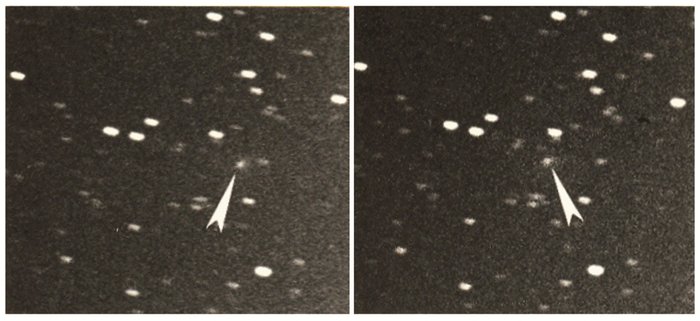


It was 45 years ago when astronomer Klim Churyumov and Svetlana Gerasimenko, one of his researchers, unwittingly began a new chapter in the history of space exploration.
During a comet-hunting expedition to Alma-Ata Observatory, Kazakhstan, they discovered the bizarre, ice-rich object – subsequently named Comet 67P/Churyumov–Gerasimenko – that is now under close scrutiny by ESA’s Rosetta spacecraft.
In November 2014 it is hoped that more secrets will be revealed when Rosetta’s Philae attempts the first soft-landing on the nucleus of a comet.
These two images, taken with a wide-angle Schmidt telescope, were exposed a short time apart during the historic expedition. The pair of photographic plates, taken by Klim Churyumov on 21 September 1969, shows a fuzzy object (indicated by the arrows) shifting position slightly in the night sky.
The comet appears indistinct because its solid heart is surrounded by a coma of gas and dust, material that was ejected into space as the ice-rich nucleus was warmed by solar radiation.
Before the era of digital cameras, imaging astronomical objects was a slow, painstaking process involving lengthy exposures of the same part of the sky on glass plates that were coated with a light-sensitive emulsion.
Glass-backed plates, rather than film, were commonly used in astronomy because they did not shrink or deform noticeably in the development process or under different environmental conditions. They were held in large-format frames for wide-field imaging.
Each successive plate was exposed after an interval of 20–30 minutes. The plates then had to be taken back to the laboratory to be processed and studied. By comparing the images, it was possible to find new comets and other fast-moving objects as they shifted across the background of more distant, ‘fixed’ stars.
Since the discovery of this comet, advances in space exploration have revolutionised comet studies, starting with the first close-up images of comet Halley obtained by ESA’s Giotto spacecraft in 1986. Since then, a handful of comets has been visited by spacecraft and some comet dust has been brought back to Earth.
These studies show that comets can no longer be regarded simply as dirty snowballs. Ideas about their origins and nature have greatly altered and there are still many questions – which Rosetta and its Philae lander could go a long way towards answering.
Member
Posts: 28,331
Joined: Jun 9 2007
Gold: 11,700.00
Oct 21 2014 07:37am


Four-image montage comprising images taken by Rosetta's navigation camera on 18 October from a distance of 9.8 km from the centre of Comet 67P/Churyumov-Gerasimenko (about 7.8 km from the surface). The image scale is 66.5 cm/pixel, so each 1024 x 1024 pixel frame making up the montage is about 680 metres across.

btw, exposure time for each frame is ~6 seconds
Member
Posts: 28,331
Joined: Jun 9 2007
Gold: 11,700.00
Oct 23 2014 02:21pm
Another picture from September they have finally released:


Rosetta OSIRIS wide-angle camera image of Comet 67P/Churyumov-Gerasimenko on 10 September 2014, showing jets of cometary activity along almost the entire body of the comet.
Member
Posts: 16,404
Joined: Mar 28 2009
Gold: 7.69
Oct 23 2014 09:07pm
This is really cool although I don't understand most of the terminology or acronyms.
Go Back To Science, Technology & Nature Topic List
Prev18910111251Next
Add Reply New Topic New Poll