Quote (russian @ Jan 11 2017 02:18pm)
What do you mean by "slow down the dispersion"? And if you think the glass portion of the mirror is important, do you think the experiment wouldn't work with a metallic mirror? If I stick a shiny piece of metal in water, would it produce a rainbow? No glass at all, just reflection.
https://en.wikipedia.org/wiki/Dispersion_(optics)In optics, dispersion is the phenomenon in which the phase velocity of a wave depends on its frequency.[1] Media having this common property may be termed dispersive media.
The most familiar example of dispersion is probably a rainbow, in which dispersion causes the spatial separation of a white light into components of different wavelengths (different colors).
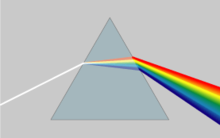
In a dispersive prism, material dispersion (a wavelength-dependent refractive index) causes different colors to refract at different angles, splitting white light into a rainbow.
I thought you already knew this because the video you posted talked about this , that the rainbow is not just refraction, light needs to disperse as well, (slow down its frequency)
This is why you need the glass (or the glass of a mirror) in your experiment.
Quote (Gratuitous @ Jan 12 2017 12:52am)
Imma just leave this here
http://www.youtube.com/watch?v=G-ZVnK7GYbQ
Hollow Earth Theory is the original psy-op to make you think the world is a ball.
This post was edited by card_sultan on Jan 12 2017 06:59am