d2jsp
Log InRegister
d2jsp Forums > Off-Topic > General Chat > Homework Help > Math Help > Inequality
Add Reply New Topic New Poll
Member
Posts: 167
Joined: Oct 2 2014
Gold: 0.00
Oct 14 2015 09:11pm
can sum1 help explain/show why the sum from i= 0 to 4 of x^i/i! > 0 for all real numbers x?
Member
Posts: 32,925
Joined: Jul 23 2006
Gold: 3,804.50
Oct 14 2015 09:27pm
(x^0 / 0!) + (x^1 / 1!) + (x^2 / 2!) + (x^3 / 3!) + (x^4 / 4!)
(1) + (x) + (x^2 / 2) + (x^3 / 6) + (x^4 / 24)

i think it's pretty obvious for x >= 0 since every term is non-negative.

just look at a graph to show it. you can see the highest power is x^4, so it has a somewhat parabola feel to it. you can take the derivative and set it equal to zero (and also the second derivative) to find the min/max and any inflection points. you'll find that it's always positive

https://mathway.com/graph

This post was edited by carteblanche on Oct 14 2015 09:31pm
Member
Posts: 167
Joined: Oct 2 2014
Gold: 0.00
Oct 19 2015 03:41pm
Quote (carteblanche @ Oct 14 2015 11:27pm)
(x^0 / 0!) + (x^1 / 1!) + (x^2 / 2!) + (x^3 / 3!) + (x^4 / 4!)
(1) + (x) + (x^2 / 2) + (x^3 / 6) + (x^4 / 24)

i think it's pretty obvious for x >= 0 since every term is non-negative.

just look at a graph to show it. you can see the highest power is x^4, so it has a somewhat parabola feel to it. you can take the derivative and set it equal to zero (and also the second derivative) to find the min/max and any inflection points. you'll find that it's always positive

https://mathway.com/graph


i get the derivative to be 1 + x + x^2/2 + x^3/6

setting it equal to 0 how do i solve it without using any technology?
Member
Posts: 12,427
Joined: Mar 4 2006
Gold: 5,077.00
Oct 19 2015 04:54pm
I'm confused on why this is a question. It is clear by definition that for I=1:4 that x^i is positive and clearly i! Must be positive based on conditions of I. Thus it's clearly positive.


Edit: You are simply wasting your time taking deriv and trying to solve for x when it is clear by definition the every part of the problem is positive.

This post was edited by Xx Shin3d0wn xX on Oct 19 2015 04:55pm
Member
Posts: 167
Joined: Oct 2 2014
Gold: 0.00
Oct 19 2015 05:54pm
Quote (Xx Shin3d0wn xX @ Oct 19 2015 06:54pm)
I'm confused on why this is a question. It is clear by definition that for I=1:4 that x^i is positive and clearly i! Must be positive based on conditions of I. Thus it's clearly positive.


Edit: You are simply wasting your time taking deriv and trying to solve for x when it is clear by definition the every part of the problem is positive.


x^i isnt always positive. ex: i is odd
Member
Posts: 32,925
Joined: Jul 23 2006
Gold: 3,804.50
Oct 19 2015 06:18pm
Quote (2wo1ne @ Oct 19 2015 05:41pm)
i get the derivative to be 1 + x + x^2/2 + x^3/6

setting it equal to 0 how do i solve it without using any technology?


that's a cubic, which has a general solution.
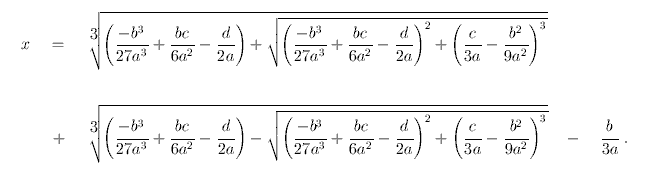

There might be a more algebraic way, but i dont care enough to look lol. perhaps wiki will you give an idea. https://en.wikipedia.org/wiki/Cubic_function

Quote (Xx Shin3d0wn xX @ Oct 19 2015 06:54pm)
I'm confused on why this is a question. It is clear by definition that for I=1:4 that x^i is positive and clearly i! Must be positive based on conditions of I. Thus it's clearly positive.


Edit: You are simply wasting your time taking deriv and trying to solve for x when it is clear by definition the every part of the problem is positive.

it's negative for x < 0 and odd i

This post was edited by carteblanche on Oct 19 2015 06:32pm
Member
Posts: 12,427
Joined: Mar 4 2006
Gold: 5,077.00
Oct 19 2015 08:02pm
Quote (2wo1ne @ Oct 19 2015 06:54pm)
x^i isnt always positive. ex: i is odd


i read the problem wrong I thought it said for a positive integer X.
Member
Posts: 118
Joined: Jun 30 2014
Gold: 0.00
Oct 20 2015 08:34pm
Here's a little trick you can try using when tackling these types of problems (complete the square)

So you start off with
1 + x + x^2/2! + x^3/3! + x^4/4!

First off multiply the entire equation by 4! to get

24 + 24x + 12x^2 + 4x^3 + x^4

rewrite as
(x^4 + 4x^3 + 6x^2 + 4x + 1) + 6x^2 + 20x + 23
= (x+1)^4 + 6x^2 + 20x + 23
add and subtract 400/24
= (x+1)^4 + (6x^2 + 20x + 400/24) - 400/24 + 23
= (x+1)^4 + (√(6)x + 20/(2√6))^2 + 19/3

the first 2 terms are ≥0 since they are both raised to an even power. Clearly 19/3 is positive, when you add them up to get something >0
Member
Posts: 167
Joined: Oct 2 2014
Gold: 0.00
Oct 22 2015 07:33pm
Quote (carteblanche @ Oct 19 2015 08:18pm)
that's a cubic, which has a general solution.
http://www.math.vanderbilt.edu/~schectex/courses/cubic/cubic.gif

There might be a more algebraic way, but i dont care enough to look lol. perhaps wiki will you give an idea. https://en.wikipedia.org/wiki/Cubic_function


it's negative for x < 0 and odd i


thx

Quote (cdexswzaq @ Oct 20 2015 10:34pm)
Here's a little trick you can try using when tackling these types of problems (complete the square)

So you start off with
1 + x + x^2/2! + x^3/3! + x^4/4!

First off multiply the entire equation by 4! to get

24 + 24x + 12x^2 + 4x^3 + x^4

rewrite as
(x^4 + 4x^3 + 6x^2 + 4x + 1) + 6x^2 + 20x + 23
= (x+1)^4 + 6x^2 + 20x + 23
add and subtract 400/24
= (x+1)^4 + (6x^2 + 20x + 400/24) - 400/24 + 23
= (x+1)^4 + (√(6)x + 20/(2√6))^2 + 19/3

the first 2 terms are ≥0 since they are both raised to an even power. Clearly 19/3 is positive, when you add them up to get something >0


thx. never liked completing hte squre, but i guess it can be useful
Member
Posts: 9,099
Joined: Nov 23 2002
Gold: 2,911.26
Oct 23 2015 04:45am
Quote (2wo1ne @ Oct 19 2015 04:41pm)
i get the derivative to be 1 + x + x^2/2 + x^3/6

setting it equal to 0 how do i solve it without using any technology?


you can always use newton-raphson to converge on the solution as well in a few iterations, which would be quicker than completing the squares
Go Back To Homework Help Topic List
Add Reply New Topic New Poll