d2jsp
Log InRegister
d2jsp Forums > Off-Topic > General Chat > Pets > My 75 Gallon > Mixed Reef
123Next
Add Reply New Topic New Poll
Member
Posts: 18,179
Joined: Jan 31 2007
Gold: 6,864.11
Nov 27 2011 07:05pm
Full Tank Shots:
2011:04:04 13:16:15:


2011:07:10 20:20:53


today (2011:11:27 17:19:24):


Livestock
Fish
Two True Perc Clownfish
Three Blue/green Chromis
Two Yellow Tail Damsels
One Foxface
One Bristletooth Tang
One Strawberry Bassleet

Inverts:
One Scarlet Cleaner Shrimp
Mixed Snails and Hermits


Next update:
Coral.
Lighting, Filtration, and Plumbing
Member
Posts: 18,179
Joined: Jan 31 2007
Gold: 6,864.11
Nov 27 2011 08:04pm
Coral


SPS
assorted montiporas and acroporas

LPS
green frogspawn
small brain
few candy cane heads
watermelon chalice

Soft
purple mushrooms
red mushrooms
red w/ purple spot mushrooms
large toadstool
green star polyps
metallic green star polyps


Next update:
Lighting, Filtration, and Plumbing
Member
Posts: 18,179
Joined: Jan 31 2007
Gold: 6,864.11
Nov 27 2011 08:21pm
Lighting & Filtration

DIY LED Lighting and Canopy
The canopy was built in my garage to hold my lights, and electrical equipment to run them. The lighting is made up of 72 total 3w Cree LEDs, 48 blue and 24 white which give the tank a 20k color temperature.
The lighting ballasts are wired to my Digital Aquatics ReefKeeper Lite which controls their dimming on and off. The blues are on for 10 hours while the whites are on for 9. The timers are offset my 1/2 hour to give a total blue sunrise/sunset every day.
I also have LED moonlights that are on a 28 day lunar cycle. These turn on an hour after the main lights are off.


Filtration (old)
The old filtration was an in cabinet DIY refugium and sump. The fuge held chaeto algae and a deep sand bend. The skimmer was a Reef Octopus external recirculating protein skimmer.
This setup is now out of commission since I am in the process of making a basement sump area.


Equipment
ReefKeeper Lite (RKL): aquarium controller set to control lights, temperature,
Skimmer: Reef Octopus external recirculating, rated up to 110 gallons.
Powerheads: two EcoTech Vortech MP10w pumps with controllers. linked wireless communication both set on reef crest mode.
main pump: Panworld external. will pump from basement up to display tank.
Heater: 200w submersible heater. heater controlled by temp probe and RKL to maintain constant temperature in tank.


Next update:
Basement Sump, Filtration, and Frag Tank
Member
Posts: 45
Joined: Nov 25 2011
Gold: 1.00
Nov 27 2011 08:26pm
Aw, I am so envious. I had a 45 gallon once, but fresh water only. I always wanted salt water.
I am told that it's a lot harder, in terms of finance, resources, and time, to maintain saltwater aquariums.
Do you have any tips for people who might be interested in starting a salt water tank?
Member
Posts: 18,179
Joined: Jan 31 2007
Gold: 6,864.11
Nov 27 2011 09:24pm
Quote (spongedude @ Nov 27 2011 08:26pm)
Aw, I am so envious. I had a 45 gallon once, but fresh water only. I always wanted salt water.
I am told that it's a lot harder, in terms of finance, resources, and time, to maintain saltwater aquariums.
Do you have any tips for people who might be interested in starting a salt water tank?


i would agree that saltwater is more costly (each water change requires salt mix). especially when you bring corals into the mix since they need better lighting and filtration.
as far as resources go, we have the internet. i'd say there isn't much difference really.
In terms of time, I dont think there is much difference there either, though ive never had freshwater fish. all you need to do is a weekly 10% weekly or 20% bi-weekly water change. that doesn't take much time. aside from water changes, you never have to clean the tank, thats what snails and algae grazing fish are for.

helpful tips:
1. don't waste money on inferior products. if you buy lesser products in the beginning you will just spend more money updating them later. ie, don't buy cheap lighting, filtration (protein skimmer), pumps, or heaters.
2. start slow and setup a plan. don't setup a tank, throw lots of fish and coral in it all in one day. also plan out everything you want to keep in your tank. this way all your livestock will get along with each other and be in the correct size tank. Also you will have proper equipment (lighting and skimmer) from day 1, instead of having to update it at a later time.
3. start with the largest size tank you can afford to keep. smaller tanks are harder to maintain (less water = harder to keep constant parameters)
4. understock! if you understock your tank with less fish then it can handle you will be able to wait longer to do water changes since you water will stay clean for longer.
Member
Posts: 33,701
Joined: Jul 17 2006
Gold: 1,990.00
Nov 27 2011 10:41pm
ive always wanted to to throw a beta fish into someones aquarium
or buy like 8 beta fish and have a bracket like march madness to see which beta is alpha

This post was edited by Kamikizzle on Nov 27 2011 10:42pm
Member
Posts: 49,618
Joined: Jun 1 2009
Gold: 2.34
Warn: 10%
Nov 27 2011 10:57pm
Quote (Kamikizzle @ Nov 27 2011 10:41pm)
ive always wanted to to throw a beta fish into someones aquarium
or buy like 8 beta fish and have a bracket like march madness to see which beta is alpha


Kamikizzle'd
Member
Posts: 47,890
Joined: Sep 15 2009
Gold: 4.21
Warn: 60%
Nov 28 2011 05:44am
nice. put a shark in it.
Member
Posts: 40,915
Joined: Jul 8 2009
Gold: 0.00
Nov 28 2011 09:44am
Very cool dude.

Keep updating this.
Member
Posts: 18,179
Joined: Jan 31 2007
Gold: 6,864.11
Nov 28 2011 06:29pm
The Basement Sump

Since water changes are annoying to do in a enclosed area, like under a tank. I figured i'd move my sump, and all the filtration, a little farther downwards, like the basement.
The basement sump area is divided into 3 sections. The live rock and algae fuge, the frag tank, and the water change tank.

The Fuge
Using my old 30 gallon tank, I put 4 holes in it 2 drains and 2 returns. 1 hole is the to drain to send water from the fuge into the frag tank. The second hole (lower in the tank) is to drain old water out of the system into the sewer as well as work as a drain for a closed loop to circulate the water using one of the returns.
The second return is to pump in freshly mixed salt water from one of the 10 gallon mixing tanks.
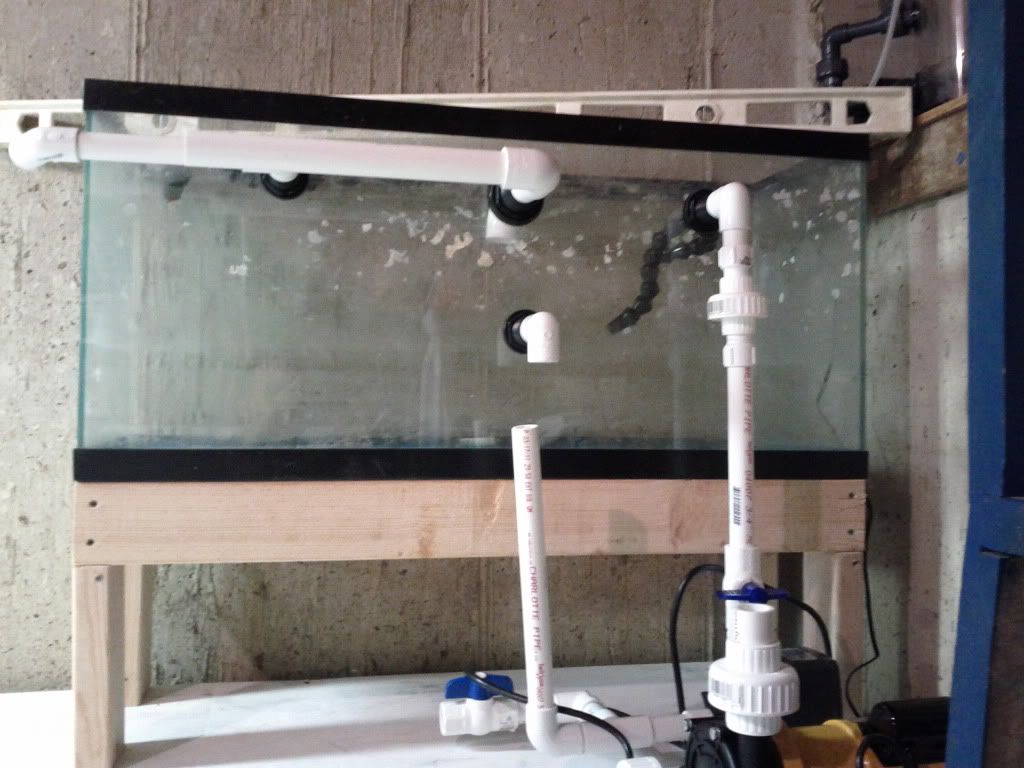

Now in this tank I will keep 2 main staples of the coral reef biological filtration, live rock and macro algae. Each will work biologically to keep the water free of ammonia, phosphates, nitrites, and nitrates.
Water will drain from my display tank and flow through the floor/walls into this tank first
This tank will have basic lighting over it to keep the algae alive. There will also be 1-2 fish as well as snails and crabs.

Water Change Tanks
I have two 10 gallon tanks i will be using to mix salt water and add into the system using a pump.
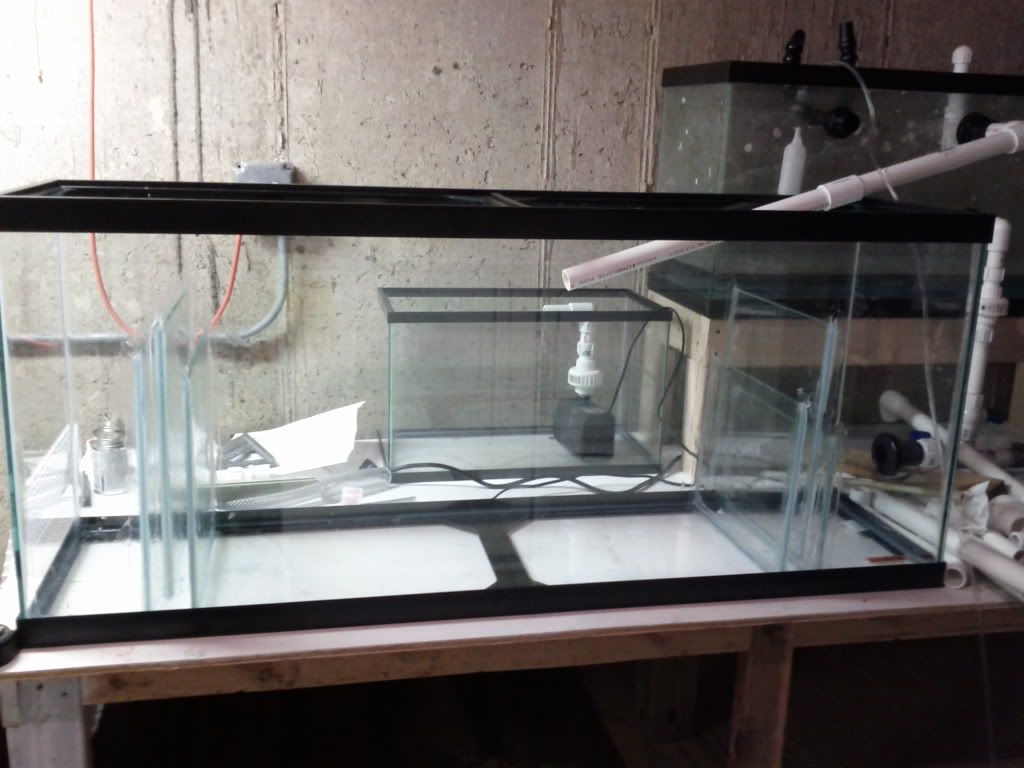

pictured here is the empty frag tank. Behind it you can see the WC tank.
Since i don't want any algae or cycling on accident in the WC tanks, they will most likely go underneath the table.


The Frag Tank
Frag: as in fragment.
A frag in the aquarium world is a small piece of coral cut off of a larger group or colony.
Fragging is the act of cutting your coral apart and growing each small piece into its own colony.

The frag tank i am setting up will be to do this with my own coral. This will give me the chance to multiply my coral much faster, as well as the ability to sell or trade to other reefers.
The tank is made out of a 55 gallon tank and set up with baffles to stop bubbles from reaching my display tank. The frag tank is illuminated by two Ecoxotic Par 38 LED bulbs with roughly the same 20k color temperature as my display tank.
These lights will be on the same schedule as the 30 gallon tank. There will also be 2 tiers of shelving to sit corals on. Different height shelving will allow for different amounts of light penetration in the water. The frag tank will probably house 1-2 small fish.
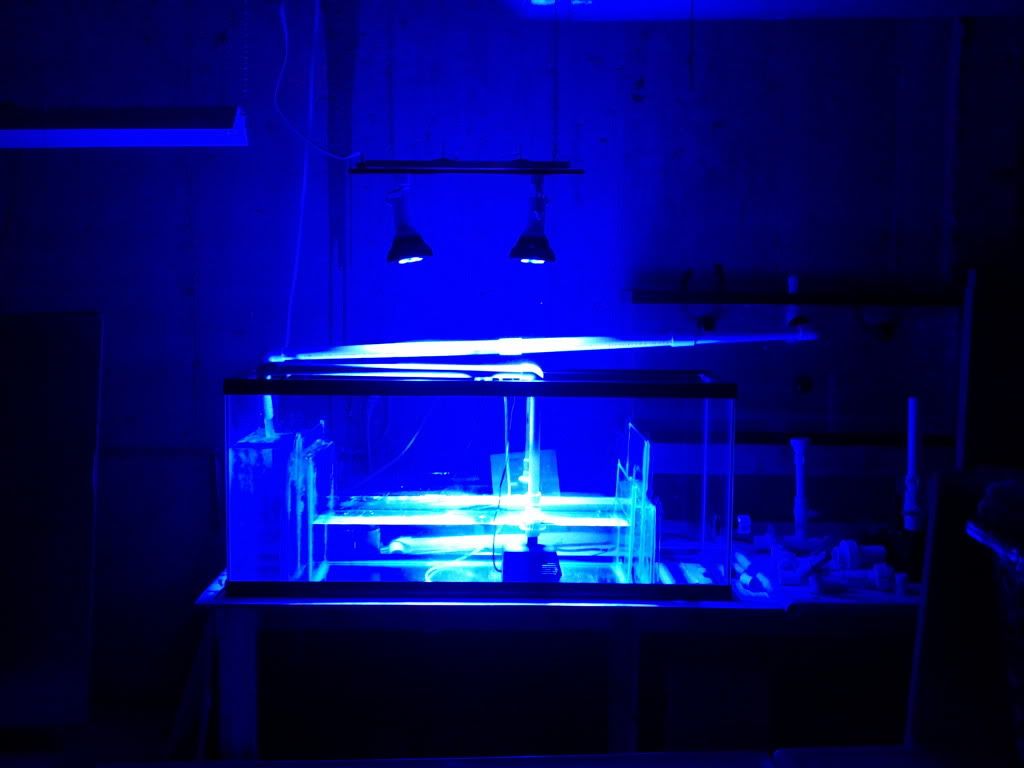

(picture taken while wet testing)
Go Back To Pets Topic List
123Next
Add Reply New Topic New Poll