Quote (Scaly @ Sep 13 2014 03:15pm)
The professor was wrong
I'm not trying to be insulting. You may have aced your class but what your class taught you was wrong.
Quote
William Blackstone (1723-80) in his 'Commentaries on the Laws of England' refers to an ancient law that permitted 'domestic chastisement'. He said: 'The husband ... by the old law, might give his wife moderate correction. For, as he is to answer for her misbehaviour, the law thought it reasonable to intrust him with this power of restraining her, by domestic chastisement, in the same moderation that a man is allowed to correct his apprentices or children...for whom the master or parent is also liable in some cases to answer. But this power of correction was confined within reasonable bounds and the husband was prohibited from using any violence to his wife [other than as lawfully and reasonably pertains to the husband for the rule and correction of his wife]. ... But with us, in the politer reign of Charles the Second [1660-1685], this power of correction began to be doubted; and a wife may now have security of the peace against her husband'...'Yet the lower rank of people, who were always fond of the old common law, still claim and exert their ancient privilege: and the courts of law will still permit a husband to restrain a wife of her liberty, in case of any gross misbehaviour.'
As can be seen by his wording, the 'old law' was applicable for 'correction' of someone who has misbehaved in such a way that the man in question has to answer for it publicly. It did not allow a man to beat his wife just because his dinner was late or because she disobeyed an order. Yet when such cases came to court, men claimed their violence was allowed 'under the old law'.
William Townsend, in 'The Lives of Twelve Eminent Judges of the Last and of the Present Century' (1846)notes that Dr Marmaduke Coghill, judge of the Prerogative Court for Ireland, in relation to a defendant who had beaten his wife, that 'moderate chastisement [with a switch] was within the husband's matrimonial privilege'.
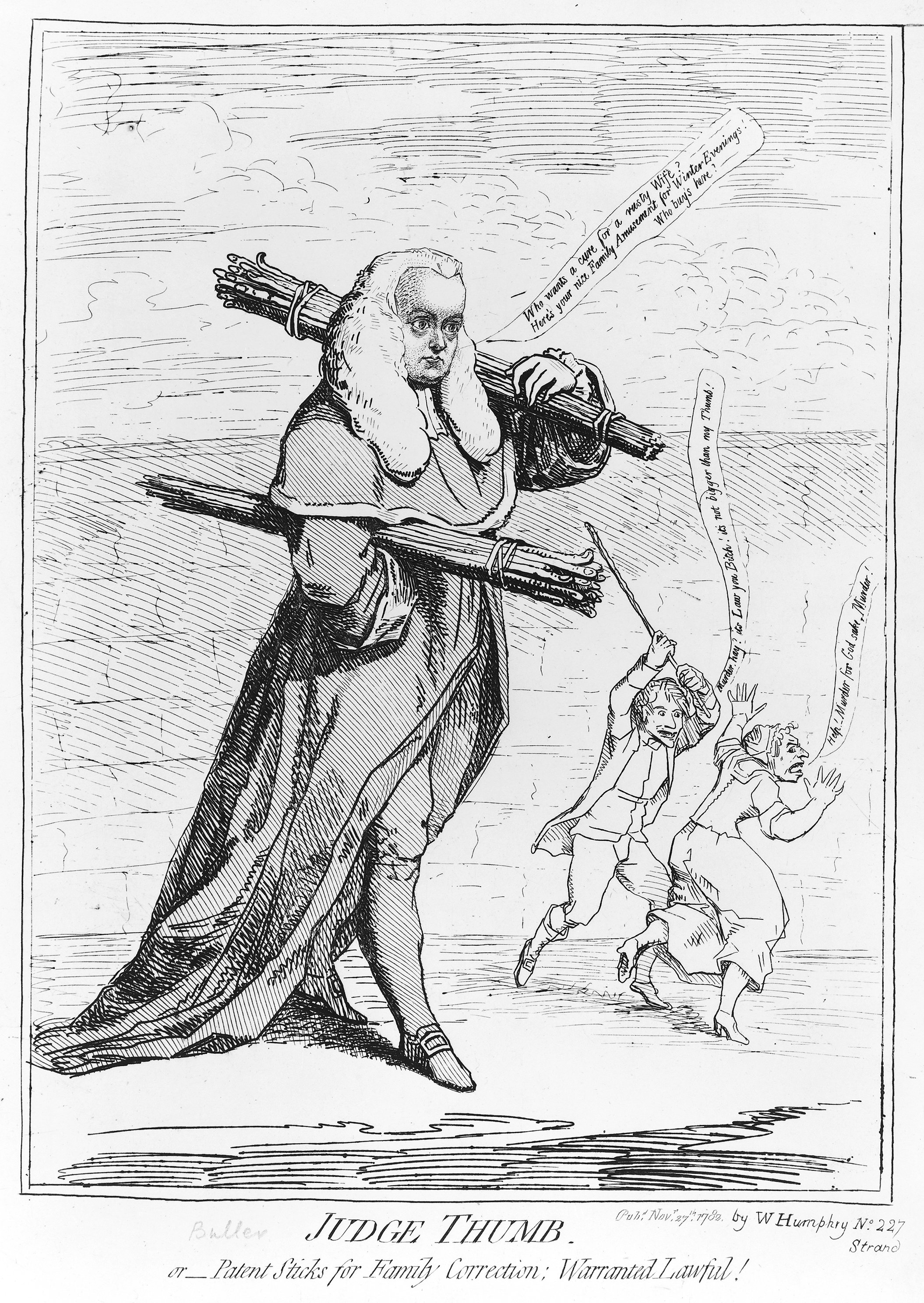
Francis Buller, a judge from 1778 to 1800, opined in 1782 that a man had the right to beat his wife and cited the 'stick no thicker than his thumb' myth. On November 27th a caricature by James Gillray entitled 'Judge Thumb. The nickname stuck for many years after his death.
Quote
'Judge Thumb: or, Patent Sticks for Family Correction: warranted Lawful!' depicts a judge in robes with bundles of long, thin sticks. The judge is saying 'Who wants a cure for a nasty Wife? Here's your nice Family Amusement for Winter Evenings... Who buys here?' A wife being beaten by her husband is shrieking 'Help! Murder for God sake, Murder!' and the husband is replying 'Murder, hey? It's Law you Bitch! It's not bigger than my Thumb!'
The 1790 book 'Strictures on the Lives and Characters of the Most Eminent Lawyers of the Present Day' mentioned Buller's 'memorable opinion, of the RIGHT of the husband over the wife, to the exercise of the thumb-stick.'
In 1828 Nicholas Baker (72) was charged with murdering his wife (66). The prosecutor said that Baker had beat his wife to death because he had 'suspicions of infidelity' and 'had inflicted what he seemed to have considered as a proper punishment'. He asked Mr Justice Park to state 'to what extent a man was entitled to punish his wife' and whether 'the present instance exceeded the extent of that power'. The judge said a man had no such right and sentenced him to be executed.
In 1846, William Townsend, in his 'Lives of Twelve Eminent Judges of the Last and of the Present Century' again mentioned Justice Buller's remark.
In 1851, during a murder trial at Taunton, defence counsel Mr Slade 'asserted that a man had a perfect right to beat his wife' and quoted Justice Buller. The judge said there was no foundation for that statment. The editor of Trewman's Exeter Flying Post (24 April) remarked: 'The ladies of Great Britain owe a debt of gratitude to the Lord Chief Baron for thus exploding a popular error'.
In 1852 in the case of Wyatt v. Burchell at Whitechapel, the judge stated that 'a married man had, by law, a right to chastise his wife'.
In 1864 Raymond Haynes, a medical doctor, after thrashing his wife with a horse-whip, told her that legally he could beat her 'with anything not thicker than his thumb'.
In 1870 Edward Foss, in his 'Biographical Dictionary of the Judges of England' says that Buller is 'equally celebrated among both females and males, but not with equal admiration. While he is considered by the latter as one of the most learned of lawyers, he is stigmatised by the former as one of the most cruel of judges, since to him is attributed the obnoxious and ungentlemanly dictum that a husband may beat his wife, so long that the stick with which he administers the castigation is not thicker than his thumb. It may perhaps restore him to the ladies' good graces to be told that, though the story was generally believed ... no substantial evidence has been found that he ever expressed so ungallant an opinion.'
In 1872 a judge told a wife-beater: 'You seem to be under the impression - which I am sorry to say is shared by a great many persons in your condition of life - that you have a right to beat your wife... But you have no right to do any such thing.
In 1872 the editor of The Times wrote: 'Cases whcih were tried last week might make us doubt whether some of our Judges do not still hold to the principle thatan Englishman may do what he likes with his own, and, within certain limits, may beat his wife as much as he pleases (16 April).
In 1885 'a young labourer in Canning Town who was remonstrated with by a bystander for knocking his wife down, thought it a sufficient answer to say that he was her lawful husband'. (He served a month's hard labour for the assault.)
In 1894 a barrister called Edward Brennan who was habitually violent to his wife, told her that a husband had a right to beat his wife as long as the stick was no longer than a huband's finger.'
This 'Common Law' was still being cited as a defence by brutal husbands right up until the 20th century, though magistrates and judges were frequently announcing that there was no such law. Less frequently, a magistrate accepted the plea that a man has a right to beat his wife.
The right of a husband to chastise has been mentioned in both Houses a few times and quite recently in the Press.
In the House of Lords on 26 May 1853 Earl Granville mentioned 'the horrible cases of assault which constantly met the public eye in the columns of the morning journals, because he believed they were perfectly aware how numerous were the cases of great cruelty, wholly wanton and unprovoked, committed by brutal husbands upon their defenceless wives and children. There was an old jocular proverb which, however absurd and ridiculous it might be, had perhaps not been without its evil effects in its way: "A woman, a dog, and a walnut tree," "The more they are beaten, the better they'll be." However execrable the doctrine might be, the fact was, that the law, as it at present stood, gave greater protection, both to the tree and to the dog, than it did to the unfortunate woman. A person was liable to corporal punishment for cutting a shrub, and might be imprisoned for three months, with or without hard labour, for ill-treating a dog; but in the case of a woman he might be fined £5, and in default only of that payment might be committed to prison. It was true that the magistrate might send the case to the sessions; but in that event justice was frequently perverted, for there was an amount of restraint and intimidation used against the unfortunate woman, which prevented the prosecution of the indictment.
In the Commons on 12 March 1856 Mr W. Williams said that 'the cases of wife-beating which appeared almost daily in the newspapers were a disgrace to England, and to humanity itself. All kinds of imprisonment had been tried and failed; the crime still continued.
In the Commons on 31 March 1871 Sir George Jessel referred to: 'barbarous and pre-civilized times, when the wife, both in law and in fact, was rather the slave than the companion of her husband ... In those times the wife was subject to corporeal chastisement from her husband, without any restraint short of doing her grievous bodily harm.'
In the Lords on 16 April 1891, Lord Esher said: 'It was urged before the Court of Appeal that by the law of England a husband may beat his wife with a stick no bigger than his thumb if she refuses to obey him, and that if a wife refused her husband conjugal rights [i.e. has sex with him] ... he may imprison her until she restores him conjugal rights. All that the Court of Appeal decided was that a husband cannot by the law of England, if the wife objects, lawfully do either of those things.
In the Lords on 6 May 1925 The Lord Chancellor, Viscount Cave, remarked that 'the old rule that a husband may beat his wife with a stick no thicker than his thumb has gradually disappeared.'
In the Daily Express, 29 April 1948 Judge Tudor Rees said: 'It is Common Law that a husband is entitled to chastise his wife, provided the rod he uses is not thicker than his little finger, but if he applied the law today, he might also find himself summoned for assault.' (Quoted by Jenni Murray, Daily Telegraph, 7 February 2002.)
In the Commons on 13 February 1976, Jo Richardson MP said: 'Wife beating is as old as the hills. Unfortunately there are many who believe that it is right to beat their women and that any interference from outside is an unwarranted intrusion. This problem has now become one of general public concern.Source: Hansard
In the Commons on 29 March 1995, Jean Corston MP said; 'Domestic violence has a long history' and referred to 'the old idea that a man was allowed to beat his wife so long as he did not use a stick any thicker than his thumb.' Source: Hansard
In the Sunday Mirror, 21 June, 1998, Alice Glenn claimed that: '150 years ago it was legal for a husband to beat his wife with a reed no thicker than his thumb.'
In Edinburgh's Evening News, 6 October, 1998, Gina Davidson stated: 'A hundred years ago a man was legally permitted to beat his wife - as long as the stick he used was no thicker than his thumb.'
In the Sunday Mirror 2 January, 2000, Terry Deary claimed: 'Up until 1879, it was quite legal for men to beat their wives, providing the stick they used was no thicker than their thumb.'
In The Times, 25 September 2001, Gary Slapper, director of the law programme at the Open University, claimed: 'Consider what else was "the law of marriage" at the time [1866]: [a wife] was subject to chastisement by [her husband] with any instrument provided it was no thicker than his thumb.'
In This is Wiltshire, 21 December 2001, Wiltshire's chief crown prosecutor Nick Hawkins stated: 'The expression "rule of thumb" was derived from the practice of a man being allowed to beat his wife with a stick provided it was no thicker than his thumb.'
In the Commons on 6 March 2003 Robert Key MP referred to a time when 'a man could not use a stick to beat his wife that was thicker than his thumb.'Source: Hansard
I guess you're right, me and my classicist political science professor are making all this up to slander the tea bagging British wifebeaters.