d2jsp
Log InRegister
d2jsp Forums > Off-Topic > General Chat > Political & Religious Debate > Sweden
Prev1141516171819Next
Add Reply New Topic New Poll
Member
Posts: 9,234
Joined: Jul 28 2007
Gold: 11,301.28
Sep 15 2022 04:24am
Quote (sirthom @ 15 Sep 2022 12:15)
How about a Nobel prize winning scientist?

https://i.imgur.com/acmEijs.jpg


This is the opinion of one guy, again no scientific background. (if the quote is even true, idk and i can't be arsed to research your shit)

Linus Pauling once thought people would live 25 years longer and heal hearth diseases by taking vitamine c pills.

This post was edited by BaHgerAUT on Sep 15 2022 04:26am
Member
Posts: 23,970
Joined: Feb 28 2007
Gold: 35,554.14
Warn: 10%
Sep 15 2022 04:27am
Quote (BaHgerAUT @ Sep 15 2022 05:24am)
This is the opinion of one guy, again no scientific background.

Linus Pauling once thought people would live 25 years longer and heal hearth by taking vitamine c pills.


Some horses just won't drink.
The cognitive dissonance is too strong.

Member
Posts: 9,234
Joined: Jul 28 2007
Gold: 11,301.28
Sep 15 2022 04:30am
Quote (sirthom @ 15 Sep 2022 12:27)
Some horses just won't drink.
The cognitive dissonance is too strong.

https://www.youtube.com/watch?v=9h2w3kcKo3A


Let's sum up your evidence: A 70 year old quote from a white guy, a graph that any 10 year old can handcraft and implying frontal lobe dmg by drawing a straight red line in paint between 2 random pictures.

This post was edited by BaHgerAUT on Sep 15 2022 04:31am
Member
Posts: 23,970
Joined: Feb 28 2007
Gold: 35,554.14
Warn: 10%
Sep 15 2022 04:37am
Quote (BaHgerAUT @ Sep 15 2022 05:30am)
Let's sum up your evidence: A 70 year old quote from a white guy, a graph that any 10 year old can handcraft and implying frontal lobe dmg by drawing a straight red line in paint between 2 random pictures.


No, those are just things to get you to open your eyes and mind to the truth.
Go to any blacks community and you will see the truth.
Want some pics of Detroit?
Member
Posts: 9,234
Joined: Jul 28 2007
Gold: 11,301.28
Sep 15 2022 04:46am
Quote (sirthom @ 15 Sep 2022 12:37)
No, those are just things to get you to open your eyes and mind to the truth.
Go to any blacks community and you will see the truth.
Want some pics of Detroit?


Want some pics of eastern european countries like Moldova? You can't proof anything like that.

Unless you can scientifically proof that white do significantly better under the same circumstances, it's just racist shit.

This post was edited by BaHgerAUT on Sep 15 2022 04:46am
Member
Posts: 23,970
Joined: Feb 28 2007
Gold: 35,554.14
Warn: 10%
Sep 15 2022 04:51am
Quote (BaHgerAUT @ Sep 15 2022 05:30am)
Let's sum up your evidence: A 70 year old quote from a white guy, a graph that any 10 year old can handcraft and implying frontal lobe dmg by drawing a straight red line in paint between 2 random pictures.


To see what I am talking about, one need to long no further than the history of Haiti.
Haiti was once the richest colony in the western hemisphere.
Now it is the poorest.
What caused this massive turn of events?

THE CARIBBEAN STATE OF HAITI serves as a striking reminder of just how deadly the practice of slavery could be. By 1804, the combined effect of thirteen years of uprisings, murder, and terrorism had destroyed the White population of Haiti, along with all agricultural production and the economy of what was formerly the most prosperous colony in the Western Hemisphere.

The island, originally named San Domingo, had become a center of Spanish activity during the time of the conquistador Hernando Cortes. The Spanish retained a small presence on the eastern side of the island, which is today known as the Dominican Republic. The western part of the island was settled by French traders in 1697 and renamed Saint-Domingue, and it was here that the ferocious race war took place.

The local Amerinds, called Canibales by the Spanish on account of their cannibalistic habits, had been reduced to insignificance by a combination of Spanish force of arms, slavery, and European diseases to which they had no immunity. As a result, the French started importing African slaves to work in the colony.

“The Jewel in the Crown” — Supplies Half of Europe’s Sugar Needs

By 1789, San Domingue was the jewel in the French colonial crown. Its ideal climate and naturally rich soil produced more sugar, coffee, and cotton than all of the then existing colonies in North America put together. San Domingue’s sugar output supplied not only all of France’s requirements, but half of the European continent’s needs as well.

San Domingue’s wealth was legendary, and by the time of the French Revolution, some 40,000 Whites had settled in the colony. However, by this stage there were at least 450,000 Black slaves toiling in the fields to maintain the island’s prodigious agricultural output, and in addition there were approximately 27,000 mulattoes. This huge non-White population, mostly kept under conditions of slavery, provided the demographic time bomb which utterly destroyed the White colony.

French Revolution — Move to Give Non-Whites the Franchise

The French Revolution of 1789 served as a spark which ignited the long-simmering racial pressures in San Domingue. A decree by the French national assembly of May 15, 1791, gave the White and mixed-race population on the island the right to vote.

The White settlers on the island immediately protested. The aptly-named governor general of the island, Blanchelande, sent a message to Paris warning that the implementation of such a form of government would result in “a frightful civil war” and the loss of the colony for France.

The French National Assembly then rescinded the earlier decree and issued a new one saying that the colonists themselves could decide on what form of government was best for their own particular circumstances. When this news was made known in San Domingue, it heightened tensions. The mixed-race population in particular were in an uproar after being informed that they had the vote and then only a few months later told the opposite.

“Amis des Noirs” — French Revolutionaries

A strong anti-slavery lobby, Amis des Noirs (“friends of the Blacks”), developed in France, and grew increasingly powerful over the course of the revolution. This abolitionist group agitated constantly for emancipation and full political rights for both mulattoes and Blacks in San Domingue, and reacted with outrage to the second decree which took away the right to vote for the mixed-race element.

As a result of the Amis des Noir’s efforts, the French national assembly issued a third decree which gave voting rights back to mulattoes and “free blacks,” that is, those Blacks not under any form of indentured labor.

When this news was received in San Domingue, the now-armed Black population launched a violent rebellion. Whites were attacked at random, plantations burned, and the island plunged into chaos. The mixed-race population initially sided with the Whites but then switched allegiance to the Blacks.

Blacks Exterminate All Whites in Haiti

By the end of the uprising in Haiti, every White man, woman, and child had been murdered. Once the Whites had been exterminated, the Black population then turned on the mixed-race population and wiped them out as well.

Chaos Reigns for Ten Years

The chaos continued until 1802 when a detachment of twenty thousand French troops was sent by Napoleon Bonaparte to restore order to the island. The French forces, under the command of Napoleon’s brother-in-law, General Leclerc, crushed the rebellion. The insurgents were ruthlessly hunted down and the main rebel leaders forced to pledge allegiance to the new French government.

Just when the situation seemed to have stabilized, two disastrous events occurred. The first was the news that the Napoleonic government had given permission for the reinstitution of slavery, and the second was an outbreak of yellow fever on San Domingue. The possibility that the institution of slavery could return reignited Black unrest on the island. Meanwhile, the already thinly stretched French forces were decimated by disease, which killed as many as 160 soldiers per day. By August 1802, four fifths of the French troops who had arrived earlier in the year were dead.

Napoleon sent ten thousand fresh troops to bolster the beleaguered French garrison. The new troops were also laid low by yellow fever, and the rebellious Blacks, largely immune to the disease, stepped up their attacks. The security situation on the island deteriorated once again.

The conflict then took an even nastier turn. The French authorities decided that the only way to bring the twelve-year-old race war to an end was to kill all Black inhabitants over the age of twelve years. The reasoning for this was that any adult Black who had, for the previous decade at least, waged a racial war against Whites, would never meekly go back to working in the fields. The same applied to Black women, the French decided, as the females of that race had proven themselves to be even more vicious and cruel to captured Whites than their menfolk. With ruthless energy, the surviving French troops pursued their new orders, and many Blacks were killed in this arbitrary fashion. Both sides were plunged into a spiral of tit-for-tat atrocities which seemed to have no end.

French Withdraw and Blacks Rule

The outbreak of the Napoleonic Wars intervened in developments on the island. France became embroiled in a war with Britain at sea, and the French colonial possession of San Domingue came under attack. The British navy blockaded the island, cut off supplies to the French garrison, and supplied the Black rebels with guns and ammunition.

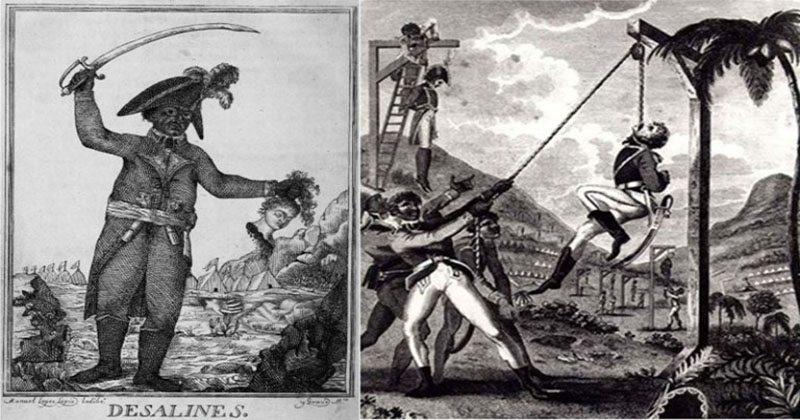
The most prominent of the Black rebel leaders, Dessalines, launched a number of attacks on the increasingly isolated French garrisons in the coastal towns. Dessalines took town after town from the weakened French forces, and systematically exterminated all the Whites taken prisoner. By November 10, 1803, the French could no longer hold out and surrendered to the British fleet off the coast. Of the fifty thousand French troops sent to the island, only a few thousand ever made it back to France.

The Massacre of the Last Whites

With the French gone, the Black leader Dessalines had a free hand in instituting his own reign of terror against any Whites still unfortunate enough to be on the island state. San Domingue was renamed Haiti in December 1803 and declared independent.

The country became the second independent nation in the Western Hemisphere (after the United States of America) and the first independent Black-ruled nation in the Caribbean.

Having disposed of the Whites, the Blacks and the mixed-race population turned on each other in yet another race war. This ended with the almost complete annihilation of the mulatto population, and in October 1804, Dessalines declared his people to be the winners. To mark the occasion, he declared himself “emperor for life” of Haiti.

The same year, Dessalines asked those Whites who had fled, to return and help rebuild the economy. A surprisingly large number of colonists took up his offer, but soon discovered the nature of their error.

Early in 1805 the Black population once again rose up against the returned White settlers. Dessalines was powerless to control the mobs, despite the White colonists’ pleas. The Europeans were hunted down and, on March 18, 1805, the very last White person in Haiti was killed.

San Domingue, which under French rule was once the richest land in all the Caribbean, is today a Third World shambles of poverty, anarchy, and chaos. This state of affairs is even more meaningful when it is considered that the independent state of Haiti is only thirty-five years younger than the United States of America.

It is a devastating counterargument to the “environmental” theory of development — because if time and environment were the only factors influencing civilization, Haiti, in theory, should be as advanced as America.


This post was edited by sirthom on Sep 15 2022 05:02am
Member
Posts: 9,988
Joined: Nov 20 2008
Gold: 5,400.00
Sep 15 2022 04:58am
With our ongoing election showing the Swedish Democrats to become second largest party in Sweden, it's evident that a lot of people are unhappy with the way things have progressed. Before mass immigration no one thought twice about SD. Fast forward 15 years and here we are.

It's worth noting that we had a lot of slavic people coming here during the 80s, successfully making their way into our society. They're different to us in some ways but a warm and kind people. Now, as for the middle easterners there's a lot to be said but I'm going to let the votes speak for themselves. The cultures are too different and kindness is being mistaken for weakness. You'd see the same thing happen in similar country like Japan but their approach to immigration have saved them a lot of trouble

I would not say any of this publicly as it's still considered inappropriate by the masses. Sweden is essentially split up into two camps of people who either consider SD patriots or nazis. Having said all that, we're not beyond saving, and with the people expressing their dissatisfaction this election it is bound to show improvements in the near future

As a side note I'd like to add that we had a Biden situation with our prime minister. They picked a halfwit to take blame for all the crazy shit they stir up behind the curtains. He's gone now, probably wondering what happened.
Member
Posts: 9,234
Joined: Jul 28 2007
Gold: 11,301.28
Sep 15 2022 05:13am
Quote (sirthom @ 15 Sep 2022 12:51)
To see what I am talking about, one need to long no further than the history of Haiti.
Haiti was once the richest colony in the western hemisphere.
Now it is the poorest.
What caused this massive turn of events?

THE CARIBBEAN STATE OF HAITI serves as a striking reminder of just how deadly the practice of slavery could be. By 1804, the combined effect of thirteen years of uprisings, murder, and terrorism had destroyed the White population of Haiti, along with all agricultural production and the economy of what was formerly the most prosperous colony in the Western Hemisphere.

The island, originally named San Domingo, had become a center of Spanish activity during the time of the conquistador Hernando Cortes. The Spanish retained a small presence on the eastern side of the island, which is today known as the Dominican Republic. The western part of the island was settled by French traders in 1697 and renamed Saint-Domingue, and it was here that the ferocious race war took place.

The local Amerinds, called Canibales by the Spanish on account of their cannibalistic habits, had been reduced to insignificance by a combination of Spanish force of arms, slavery, and European diseases to which they had no immunity. As a result, the French started importing African slaves to work in the colony.

“The Jewel in the Crown” — Supplies Half of Europe’s Sugar Needs

By 1789, San Domingue was the jewel in the French colonial crown. Its ideal climate and naturally rich soil produced more sugar, coffee, and cotton than all of the then existing colonies in North America put together. San Domingue’s sugar output supplied not only all of France’s requirements, but half of the European continent’s needs as well.

San Domingue’s wealth was legendary, and by the time of the French Revolution, some 40,000 Whites had settled in the colony. However, by this stage there were at least 450,000 Black slaves toiling in the fields to maintain the island’s prodigious agricultural output, and in addition there were approximately 27,000 mulattoes. This huge non-White population, mostly kept under conditions of slavery, provided the demographic time bomb which utterly destroyed the White colony.

French Revolution — Move to Give Non-Whites the Franchise

The French Revolution of 1789 served as a spark which ignited the long-simmering racial pressures in San Domingue. A decree by the French national assembly of May 15, 1791, gave the White and mixed-race population on the island the right to vote.

The White settlers on the island immediately protested. The aptly-named governor general of the island, Blanchelande, sent a message to Paris warning that the implementation of such a form of government would result in “a frightful civil war” and the loss of the colony for France.

The French National Assembly then rescinded the earlier decree and issued a new one saying that the colonists themselves could decide on what form of government was best for their own particular circumstances. When this news was made known in San Domingue, it heightened tensions. The mixed-race population in particular were in an uproar after being informed that they had the vote and then only a few months later told the opposite.

“Amis des Noirs” — French Revolutionaries

A strong anti-slavery lobby, Amis des Noirs (“friends of the Blacks”), developed in France, and grew increasingly powerful over the course of the revolution. This abolitionist group agitated constantly for emancipation and full political rights for both mulattoes and Blacks in San Domingue, and reacted with outrage to the second decree which took away the right to vote for the mixed-race element.

As a result of the Amis des Noir’s efforts, the French national assembly issued a third decree which gave voting rights back to mulattoes and “free blacks,” that is, those Blacks not under any form of indentured labor.

When this news was received in San Domingue, the now-armed Black population launched a violent rebellion. Whites were attacked at random, plantations burned, and the island plunged into chaos. The mixed-race population initially sided with the Whites but then switched allegiance to the Blacks.

Blacks Exterminate All Whites in Haiti

By the end of the uprising in Haiti, every White man, woman, and child had been murdered. Once the Whites had been exterminated, the Black population then turned on the mixed-race population and wiped them out as well.

Chaos Reigns for Ten Years

The chaos continued until 1802 when a detachment of twenty thousand French troops was sent by Napoleon Bonaparte to restore order to the island. The French forces, under the command of Napoleon’s brother-in-law, General Leclerc, crushed the rebellion. The insurgents were ruthlessly hunted down and the main rebel leaders forced to pledge allegiance to the new French government.

Just when the situation seemed to have stabilized, two disastrous events occurred. The first was the news that the Napoleonic government had given permission for the reinstitution of slavery, and the second was an outbreak of yellow fever on San Domingue. The possibility that the institution of slavery could return reignited Black unrest on the island. Meanwhile, the already thinly stretched French forces were decimated by disease, which killed as many as 160 soldiers per day. By August 1802, four fifths of the French troops who had arrived earlier in the year were dead.

Napoleon sent ten thousand fresh troops to bolster the beleaguered French garrison. The new troops were also laid low by yellow fever, and the rebellious Blacks, largely immune to the disease, stepped up their attacks. The security situation on the island deteriorated once again.

The conflict then took an even nastier turn. The French authorities decided that the only way to bring the twelve-year-old race war to an end was to kill all Black inhabitants over the age of twelve years. The reasoning for this was that any adult Black who had, for the previous decade at least, waged a racial war against Whites, would never meekly go back to working in the fields. The same applied to Black women, the French decided, as the females of that race had proven themselves to be even more vicious and cruel to captured Whites than their menfolk. With ruthless energy, the surviving French troops pursued their new orders, and many Blacks were killed in this arbitrary fashion. Both sides were plunged into a spiral of tit-for-tat atrocities which seemed to have no end.

French Withdraw and Blacks Rule

The outbreak of the Napoleonic Wars intervened in developments on the island. France became embroiled in a war with Britain at sea, and the French colonial possession of San Domingue came under attack. The British navy blockaded the island, cut off supplies to the French garrison, and supplied the Black rebels with guns and ammunition.

The most prominent of the Black rebel leaders, Dessalines, launched a number of attacks on the increasingly isolated French garrisons in the coastal towns. Dessalines took town after town from the weakened French forces, and systematically exterminated all the Whites taken prisoner. By November 10, 1803, the French could no longer hold out and surrendered to the British fleet off the coast. Of the fifty thousand French troops sent to the island, only a few thousand ever made it back to France.

The Massacre of the Last Whites

With the French gone, the Black leader Dessalines had a free hand in instituting his own reign of terror against any Whites still unfortunate enough to be on the island state. San Domingue was renamed Haiti in December 1803 and declared independent.

The country became the second independent nation in the Western Hemisphere (after the United States of America) and the first independent Black-ruled nation in the Caribbean.

Having disposed of the Whites, the Blacks and the mixed-race population turned on each other in yet another race war. This ended with the almost complete annihilation of the mulatto population, and in October 1804, Dessalines declared his people to be the winners. To mark the occasion, he declared himself “emperor for life” of Haiti.

The same year, Dessalines asked those Whites who had fled, to return and help rebuild the economy. A surprisingly large number of colonists took up his offer, but soon discovered the nature of their error.

Early in 1805 the Black population once again rose up against the returned White settlers. Dessalines was powerless to control the mobs, despite the White colonists’ pleas. The Europeans were hunted down and, on March 18, 1805, the very last White person in Haiti was killed.

San Domingue, which under French rule was once the richest land in all the Caribbean, is today a Third World shambles of poverty, anarchy, and chaos. This state of affairs is even more meaningful when it is considered that the independent state of Haiti is only thirty-five years younger than the United States of America.

It is a devastating counterargument to the “environmental” theory of development — because if time and environment were the only factors influencing civilization, Haiti, in theory, should be as advanced as America.

https://nationalvanguard.org/wp-content/uploads/2019/01/haitian-revolution.jpg


So you're saying a former colony island which original inhabitants were massacred and which full wealth based on slavery didn't do well after the french withdrawal while having to pay huge amounts of money for 60 years for freedom.
who
would
have
thought
that

Let's draw conclusions about all people of colour from that example. lol
If that is your argumentation line you're more frustrated than i thought.

@SEjsp: Japans population is declining and overaging. The future looks quite grim for Japan and they are thinking about loosening their immigration laws because of this.

This post was edited by BaHgerAUT on Sep 15 2022 05:21am
Member
Posts: 23,970
Joined: Feb 28 2007
Gold: 35,554.14
Warn: 10%
Sep 15 2022 05:24am
Quote (BaHgerAUT @ Sep 15 2022 06:13am)
So you're saying a former colony island which original inhabitants were massacred and which full wealth based on slavery didn't do well after the french withdrawal while having to pay huge amounts of money for 60 years for freedom didn't develop well?

who
would
have
thought
that

Let's draw conclusions about all people of colour from that example. lol
If that is your argumentation line you're more frustrated than i thought.


I am not saying anything.
Just showing you the history.
And the only thing I am frustrated with is people who can't/won't to see the truth.

My point was to show you we are not all the same and never was.
In closing, I will leave this.

Member
Posts: 9,899
Joined: May 7 2006
Gold: 550.00
Sep 15 2022 01:41pm
Quote (sirthom @ Sep 15 2022 03:51am)
To see what I am talking about, one need to long no further than the history of Haiti.
Haiti was once the richest colony in the western hemisphere.
Now it is the poorest.
What caused this massive turn of events?

THE CARIBBEAN STATE OF HAITI serves as a striking reminder of just how deadly the practice of slavery could be. By 1804, the combined effect of thirteen years of uprisings, murder, and terrorism had destroyed the White population of Haiti, along with all agricultural production and the economy of what was formerly the most prosperous colony in the Western Hemisphere.

The island, originally named San Domingo, had become a center of Spanish activity during the time of the conquistador Hernando Cortes. The Spanish retained a small presence on the eastern side of the island, which is today known as the Dominican Republic. The western part of the island was settled by French traders in 1697 and renamed Saint-Domingue, and it was here that the ferocious race war took place.

The local Amerinds, called Canibales by the Spanish on account of their cannibalistic habits, had been reduced to insignificance by a combination of Spanish force of arms, slavery, and European diseases to which they had no immunity. As a result, the French started importing African slaves to work in the colony.

“The Jewel in the Crown” — Supplies Half of Europe’s Sugar Needs

By 1789, San Domingue was the jewel in the French colonial crown. Its ideal climate and naturally rich soil produced more sugar, coffee, and cotton than all of the then existing colonies in North America put together. San Domingue’s sugar output supplied not only all of France’s requirements, but half of the European continent’s needs as well.

San Domingue’s wealth was legendary, and by the time of the French Revolution, some 40,000 Whites had settled in the colony. However, by this stage there were at least 450,000 Black slaves toiling in the fields to maintain the island’s prodigious agricultural output, and in addition there were approximately 27,000 mulattoes. This huge non-White population, mostly kept under conditions of slavery, provided the demographic time bomb which utterly destroyed the White colony.

French Revolution — Move to Give Non-Whites the Franchise

The French Revolution of 1789 served as a spark which ignited the long-simmering racial pressures in San Domingue. A decree by the French national assembly of May 15, 1791, gave the White and mixed-race population on the island the right to vote.

The White settlers on the island immediately protested. The aptly-named governor general of the island, Blanchelande, sent a message to Paris warning that the implementation of such a form of government would result in “a frightful civil war” and the loss of the colony for France.

The French National Assembly then rescinded the earlier decree and issued a new one saying that the colonists themselves could decide on what form of government was best for their own particular circumstances. When this news was made known in San Domingue, it heightened tensions. The mixed-race population in particular were in an uproar after being informed that they had the vote and then only a few months later told the opposite.

“Amis des Noirs” — French Revolutionaries

A strong anti-slavery lobby, Amis des Noirs (“friends of the Blacks”), developed in France, and grew increasingly powerful over the course of the revolution. This abolitionist group agitated constantly for emancipation and full political rights for both mulattoes and Blacks in San Domingue, and reacted with outrage to the second decree which took away the right to vote for the mixed-race element.

As a result of the Amis des Noir’s efforts, the French national assembly issued a third decree which gave voting rights back to mulattoes and “free blacks,” that is, those Blacks not under any form of indentured labor.

When this news was received in San Domingue, the now-armed Black population launched a violent rebellion. Whites were attacked at random, plantations burned, and the island plunged into chaos. The mixed-race population initially sided with the Whites but then switched allegiance to the Blacks.

Blacks Exterminate All Whites in Haiti

By the end of the uprising in Haiti, every White man, woman, and child had been murdered. Once the Whites had been exterminated, the Black population then turned on the mixed-race population and wiped them out as well.

Chaos Reigns for Ten Years

The chaos continued until 1802 when a detachment of twenty thousand French troops was sent by Napoleon Bonaparte to restore order to the island. The French forces, under the command of Napoleon’s brother-in-law, General Leclerc, crushed the rebellion. The insurgents were ruthlessly hunted down and the main rebel leaders forced to pledge allegiance to the new French government.

Just when the situation seemed to have stabilized, two disastrous events occurred. The first was the news that the Napoleonic government had given permission for the reinstitution of slavery, and the second was an outbreak of yellow fever on San Domingue. The possibility that the institution of slavery could return reignited Black unrest on the island. Meanwhile, the already thinly stretched French forces were decimated by disease, which killed as many as 160 soldiers per day. By August 1802, four fifths of the French troops who had arrived earlier in the year were dead.

Napoleon sent ten thousand fresh troops to bolster the beleaguered French garrison. The new troops were also laid low by yellow fever, and the rebellious Blacks, largely immune to the disease, stepped up their attacks. The security situation on the island deteriorated once again.

The conflict then took an even nastier turn. The French authorities decided that the only way to bring the twelve-year-old race war to an end was to kill all Black inhabitants over the age of twelve years. The reasoning for this was that any adult Black who had, for the previous decade at least, waged a racial war against Whites, would never meekly go back to working in the fields. The same applied to Black women, the French decided, as the females of that race had proven themselves to be even more vicious and cruel to captured Whites than their menfolk. With ruthless energy, the surviving French troops pursued their new orders, and many Blacks were killed in this arbitrary fashion. Both sides were plunged into a spiral of tit-for-tat atrocities which seemed to have no end.

French Withdraw and Blacks Rule

The outbreak of the Napoleonic Wars intervened in developments on the island. France became embroiled in a war with Britain at sea, and the French colonial possession of San Domingue came under attack. The British navy blockaded the island, cut off supplies to the French garrison, and supplied the Black rebels with guns and ammunition.

The most prominent of the Black rebel leaders, Dessalines, launched a number of attacks on the increasingly isolated French garrisons in the coastal towns. Dessalines took town after town from the weakened French forces, and systematically exterminated all the Whites taken prisoner. By November 10, 1803, the French could no longer hold out and surrendered to the British fleet off the coast. Of the fifty thousand French troops sent to the island, only a few thousand ever made it back to France.

The Massacre of the Last Whites

With the French gone, the Black leader Dessalines had a free hand in instituting his own reign of terror against any Whites still unfortunate enough to be on the island state. San Domingue was renamed Haiti in December 1803 and declared independent.

The country became the second independent nation in the Western Hemisphere (after the United States of America) and the first independent Black-ruled nation in the Caribbean.

Having disposed of the Whites, the Blacks and the mixed-race population turned on each other in yet another race war. This ended with the almost complete annihilation of the mulatto population, and in October 1804, Dessalines declared his people to be the winners. To mark the occasion, he declared himself “emperor for life” of Haiti.

The same year, Dessalines asked those Whites who had fled, to return and help rebuild the economy. A surprisingly large number of colonists took up his offer, but soon discovered the nature of their error.

Early in 1805 the Black population once again rose up against the returned White settlers. Dessalines was powerless to control the mobs, despite the White colonists’ pleas. The Europeans were hunted down and, on March 18, 1805, the very last White person in Haiti was killed.

San Domingue, which under French rule was once the richest land in all the Caribbean, is today a Third World shambles of poverty, anarchy, and chaos. This state of affairs is even more meaningful when it is considered that the independent state of Haiti is only thirty-five years younger than the United States of America.

It is a devastating counterargument to the “environmental” theory of development — because if time and environment were the only factors influencing civilization, Haiti, in theory, should be as advanced as America.

https://nationalvanguard.org/wp-content/uploads/2019/01/haitian-revolution.jpg


Super cool source.
Go Back To Political & Religious Debate Topic List
Prev1141516171819Next
Add Reply New Topic New Poll